Kent Starr is a criminal defense attorney in McKinney, Texas. He has practiced criminal defense in Collin County since 1997 and takes every consultation himself. The consultation is free and confidential: (214) 982-1408.
This article is for general informational purposes only. It is not legal advice and does not create an attorney-client relationship. Reading this page or contacting the firm does not form representation. Every case depends on its facts and the exact terms of any applicable order or bond condition. Consult a licensed Texas attorney about your situation.
You have a protective order against you. The judge told you to stay away. No contact. No texts. No calls. No showing up at the house.
Then the protected person reaches out. Maybe they text you first. Maybe they call and say they miss you. Maybe they invite you over. You think, “If they want me there, it must be okay, right?”
In Texas, that assumption is dangerous. A protective order is not a private agreement between two people. It is a court order. Only a judge can change it. If you violate it—even at the invitation of the protected person—you can be arrested, charged, and, if the State proves its case, convicted.
What Is a Protective Order Violation in Texas?
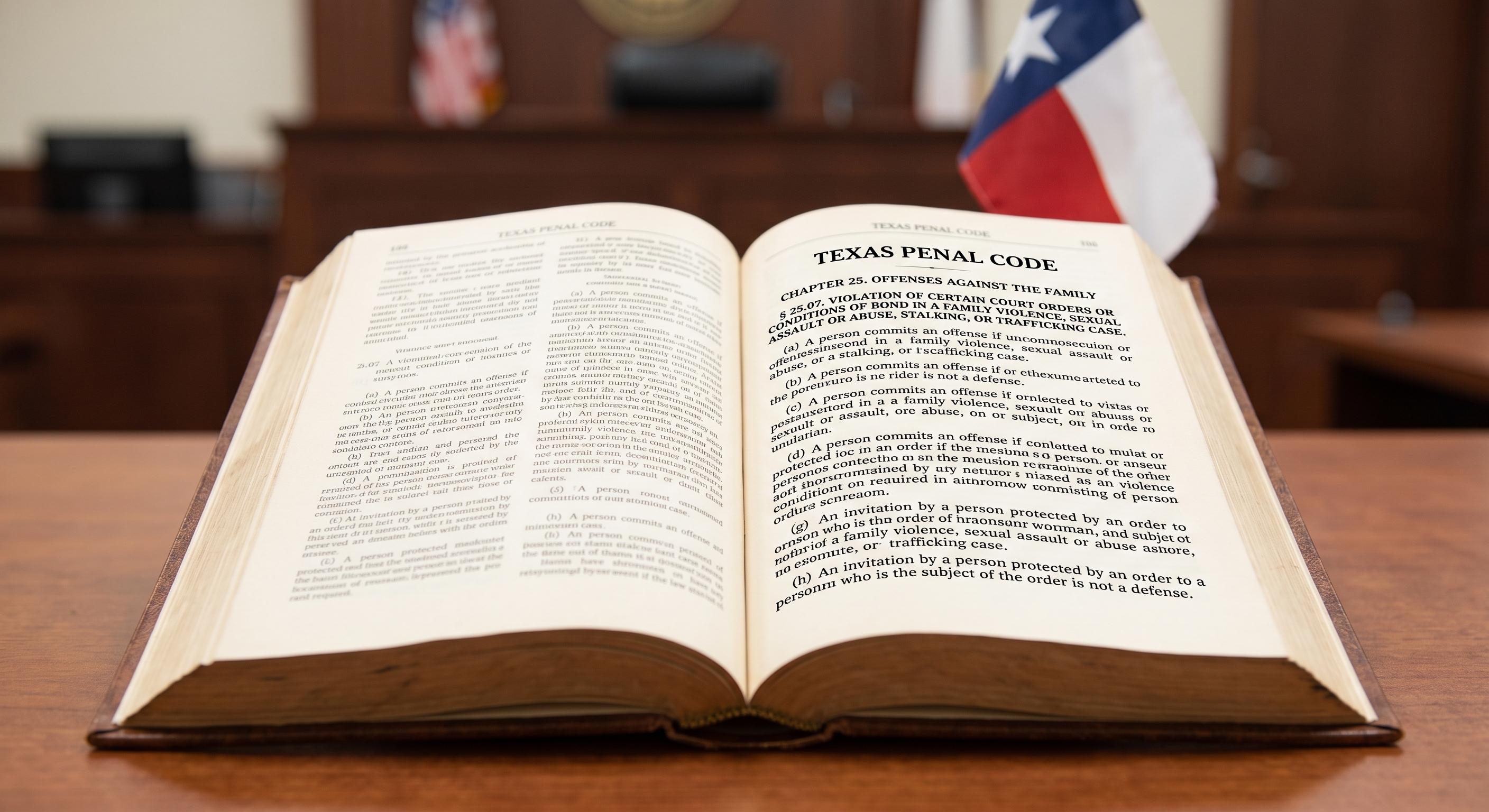
Under Texas Penal Code §25.07, a person commits an offense if, in violation of certain court orders or conditions of bond, they knowingly or intentionally engage in conduct the order or condition prohibits. Depending on the order type and wording, restricted conduct often includes:
- No contact: phone calls, texts, emails, social media messages, letters, or messages through third parties, when communication is prohibited
- Stay-away zones: remaining a required distance from listed places such as a home, workplace, or school
- Firearm restrictions: when the order or applicable law restricts possession or transfer of firearms
Liability is not automatic for every text, social-media interaction, or coincidental encounter. The State generally must prove the applicable statutory elements, including that the conduct violated the specific order or bond condition and that the person acted with the required mental state (typically knowingly or intentionally). Read your order carefully and get legal advice before responding to any outreach.
Related warning language appears in Texas Family Code §85.026: even the protected person cannot authorize someone to ignore the order.
The Critical Rule: Consent Is Not a Defense
You cannot “consent” your way around a court order. Only a judge can modify or vacate its terms. If the protected person invites you over, texts first, or asks to meet, responding or showing up can still be charged as a violation if the order prohibits that contact and the other statutory elements are met.
The Texas State Law Library explains the practical point: a protected person cannot give permission to violate a protective order; only the court can change the order.
Even an Agreement Between the Parties Will Not Protect You
You and the protected person may talk. You may agree the order was a mistake. You may both want to reconcile.
None of that, by itself, ends the order. If it remains active, contact that the order prohibits can still lead to investigation or arrest if law enforcement develops probable cause—including when a neighbor, family member, or the protected person contacts police.
A common pattern in these cases is reconciliation followed by a later report to police. Whether an arrest occurs depends on the facts and probable cause—not on informal permission from the protected person.
Law Enforcement Authority When Officers Did Not Witness the Contact
Under Texas Code of Criminal Procedure Article 14.03, arrest authority depends on the facts. In general, a peace officer may arrest without a warrant when the officer has probable cause to believe a person committed a §25.07 protective-order violation that the officer did not witness. When the officer has probable cause and the §25.07 offense occurs in the officer’s presence, the officer shall arrest. Arrest is not automatic on every civilian report, but probable cause—including from a credible report—can support an arrest decision.
That combination—court-ordered no-contact rules plus warrantless-arrest authority in qualifying situations—is why these allegations move quickly once police are involved.
Penalties for Violating a Protective Order
Penalties depend on the charging theory, prior history, and the specific facts. The ranges below reflect current Texas Penal Code §§25.07(g) and 25.072(e) (including amendments effective September 1, 2025) and the general Chapter 12 punishment ranges. This is educational only—not a charging chart.
Effective-date note: The September 1, 2025 classification changes associated with HB 2073 apply only to offenses committed on or after that date. If any element of the offense occurred before September 1, 2025, prior law governs.
| Offense level | Statutory context (simplified) | General punishment range |
|---|---|---|
| Class A misdemeanor | Default classification under §25.07 when no listed felony circumstance is proved | Up to 1 year in county jail; fine up to $4,000 |
| State jail felony | May apply under §25.07(g)(1)(A) to violation of a qualifying Chapter 7B order issued after conviction or deferred adjudication concerning the victim of that offense; or under §25.07(g)(1)(B) when specified prohibited conduct occurs while the defendant possesses a deadly weapon | 180 days to 2 years in state jail; fine up to $10,000 |
| Third-degree felony | May apply under §25.07(g)(2) based on two or more qualifying prior convictions or a violation committed by assault or stalking; it is also the default classification for repeated violation under §25.072 | 2 to 10 years in prison; fine up to $10,000 |
| Second-degree felony | May apply under §25.072(e) when at least one incident in the repeated-violation charge was punishable as a state jail felony under §25.07(g)(1)(B) | 2 to 20 years in prison; fine up to $10,000 |
Two or more qualifying §25.07 violations within a period of 12 months or less may support a §25.072 charge. Section 25.072 also contains restrictions on same-action convictions and on multiple counts involving a single court order or single setting of bond. A conviction can create a lasting criminal record and may affect employment, housing, and firearm rights, subject to the judgment and other applicable law.
Conduct That Often Leads to Violation Allegations
Depending on what your order or bond condition actually prohibits, allegations commonly involve:
- Responding to a text or call from the protected person when communication is banned
- Social-media likes, comments, or messages, if that contact violates the order
- Being at a location the order makes off-limits, or remaining after you realize the protected person is present, when the order’s stay-away terms apply
- Third-party messages that the State treats as prohibited communication
- Firearm possession or access when restricted by the order or applicable law (restrictions are not identical in every case)
Whether any of these is a crime depends on the order’s terms, the statute charged, mental state, and any applicable exceptions. Do not treat this list as automatic guilt.
Defending Against Protective Order Violation Charges
Possible defense themes (fact-specific) include:
- Failure to prove that the order or bond condition was covered by §25.07 and binding under the notice, service, or proceeding requirements applicable to that order
- For a Chapter 83 temporary ex parte order, failure to prove service as §25.07(a) expressly requires
- Failure to prove that the defendant knowingly or intentionally engaged in the prohibited conduct—for example, evidence that an alleged encounter was accidental, depending on the charged theory
- Failure to prove that the conduct violated the exact restriction alleged
These themes do not mean the State must always prove actual knowledge of every provision or a specific intent to violate the order. Every case is different. The right approach depends on the record.
Violation of Protective Order: FAQs
Can I be arrested if the protected person contacted me first?
Yes, you can still face arrest or charges if you respond in a way the order prohibits and probable cause exists. The protected person’s invitation does not rewrite the order. See also Family Code §85.026’s statutory warning concept: the protected person cannot authorize ignoring the order.
What if we reconcile and want to be together?
Ask a lawyer about requesting appropriate relief from the issuing court. Unless and until the court enters an order changing or terminating the restriction, prohibited contact remains prohibited.
Will police arrest me even if the protected person does not want charges?
They may, if they have probable cause under applicable arrest authority. The protected person’s preference does not control the officer’s legal authority.
What is the penalty for a first violation?
Many first §25.07 cases are charged as Class A misdemeanors (up to 1 year in county jail and a fine up to $4,000), but enhancements and related statutes can change exposure. Confirm against the actual charge.
Can I get probation?
Sometimes. Conditions can be strict. §25.07 covers several order and bond-condition contexts (not only family-violence protective orders), so outcomes and conditions vary.
McKinney & Collin County Protective Order Violation Defense
At Starr Law, P.C., Kent Wade Starr represents people facing protective-order violation allegations in Collin County and elsewhere in Texas. These cases are often more fact-intensive than they first appear. Disputed contact, service or notice issues, and who initiated a communication may affect the evidence and defense strategy, but an invitation or agreement alone does not alter an active order.
Criminal defense in Texas since 1997.
If you are under investigation or charged, do not wait. Call (214) 982-1408 to request a free, confidential consultation. The office answers 9 AM–5 PM, seven days a week. Contacting the firm does not create an attorney-client relationship until representation is formally agreed.
References
- Texas Penal Code §25.07 (Violation of Certain Court Orders or Conditions of Bond)
- Texas Penal Code §25.072 (Repeated Violation of Certain Court Orders or Conditions of Bond)
- Texas Code of Criminal Procedure Art. 14.03
- Texas Family Code §85.026 (Warning on Protective Order)
- Texas State Law Library — Protective Orders: Enforcing an Order
Frequently asked questions
- Can I be arrested if the protected person contacted me first?
- Yes. You can still face arrest or charges if you respond in a way the order prohibits and probable cause exists. The protected person’s invitation does not rewrite the order. Texas Family Code §85.026’s warning concept is that the protected person cannot authorize ignoring the order.
- What if we reconcile and want to be together?
- Ask a lawyer about requesting appropriate relief from the issuing court. Unless and until the court enters an order changing or terminating the restriction, prohibited contact remains prohibited.
- Will police arrest me even if the protected person does not want charges?
- They may, if they have probable cause under applicable arrest authority. The protected person’s preference does not control the officer’s legal authority.
- What is the penalty for a first violation?
- Many first §25.07 cases are charged as Class A misdemeanors (up to 1 year in county jail and a fine up to $4,000), but enhancements and related statutes—including post–September 1, 2025 classifications under HB 2073 for offenses committed on or after that date—can change exposure. Confirm against the actual charge.
- Can I get probation for a protective order violation?
- Sometimes. Conditions can be strict. §25.07 covers several order and bond-condition contexts (not only family-violence protective orders), so outcomes and conditions vary.