[ 04 / Practice · Federal Criminal Defense ]
Federal Criminal Defense in McKinney & Collin County
Federal crimes lawyer for Collin County. Eastern District of Texas indictments, wire fraud, conspiracy, white collar matters, federal sentencing.
Written by Kent Starr, criminal defense attorney. Kent Starr has practiced criminal defense in Collin County since 1997. Office in McKinney, Suite 200. 5.0 on Google, 450+ reviews.
Quick answer
What makes a crime federal instead of state?
A crime becomes federal when it breaks a law passed by Congress instead of the Texas Legislature, usually because it crosses state lines, happens on federal property, targets a federal officer or program, or uses interstate commerce, such as wire fraud under 18 U.S.C. §1343. Drug conspiracies (21 U.S.C. §846) and many child pornography cases (18 U.S.C. §2252A) also land in federal court. These cases follow the Federal Rules of Criminal Procedure and the advisory U.S. Sentencing Guidelines, and federal charges arising in Collin County are heard in the Eastern District of Texas, Sherman Division.
Federal criminal charges occupy a different world from state prosecutions. The rules of evidence, the speed of indictment, the sentencing math, and the relative power of the prosecutor are all weighted in ways that often surprise people who have only experienced the state system. If you have been contacted by an FBI, DEA, ATF, IRS-CI, or Homeland Security agent, or if you have already been served with a federal target letter or grand jury subpoena, the next decisions you make will shape the rest of your case. Kent Starr has defended serious felony allegations in North Texas since 1997, and the federal practice he has built draws on the academic and appellate work he started in the 1990s.
Federal defense is decided by preparation and experience, not the size of a letterhead. At Starr Law you work with Kent directly at every stage of a federal case, the lawyer who has tried serious felonies since 1997, holds an LL.M. in tax law, and is admitted to the federal district courts that hear these cases, not a rotating cast of junior associates. When a case calls for it, he works with the right forensic accountants, digital examiners, and investigators to meet the government's resources where they count.
Federal jurisdiction reaches further than most people realize. A drug case that crosses a state line, a wire fraud allegation that touches a single email server in another district, a firearm enhancement attached to a state-level offense, a conspiracy charge alleging two or more participants, all of these can lift a prosecution from state court into the federal system. Kent represents clients facing federal drug trafficking allegations, white-collar charges (wire fraud, mail fraud, healthcare fraud, tax fraud), conspiracy indictments, federal weapons charges, and the federal exposure that can attach to immigration and child-pornography cases. Many of these matters begin long before charges are filed, in the proffer-and-target-letter phase, where the most consequential decisions about cooperation, immunity, and trial posture are made.
In Collin County
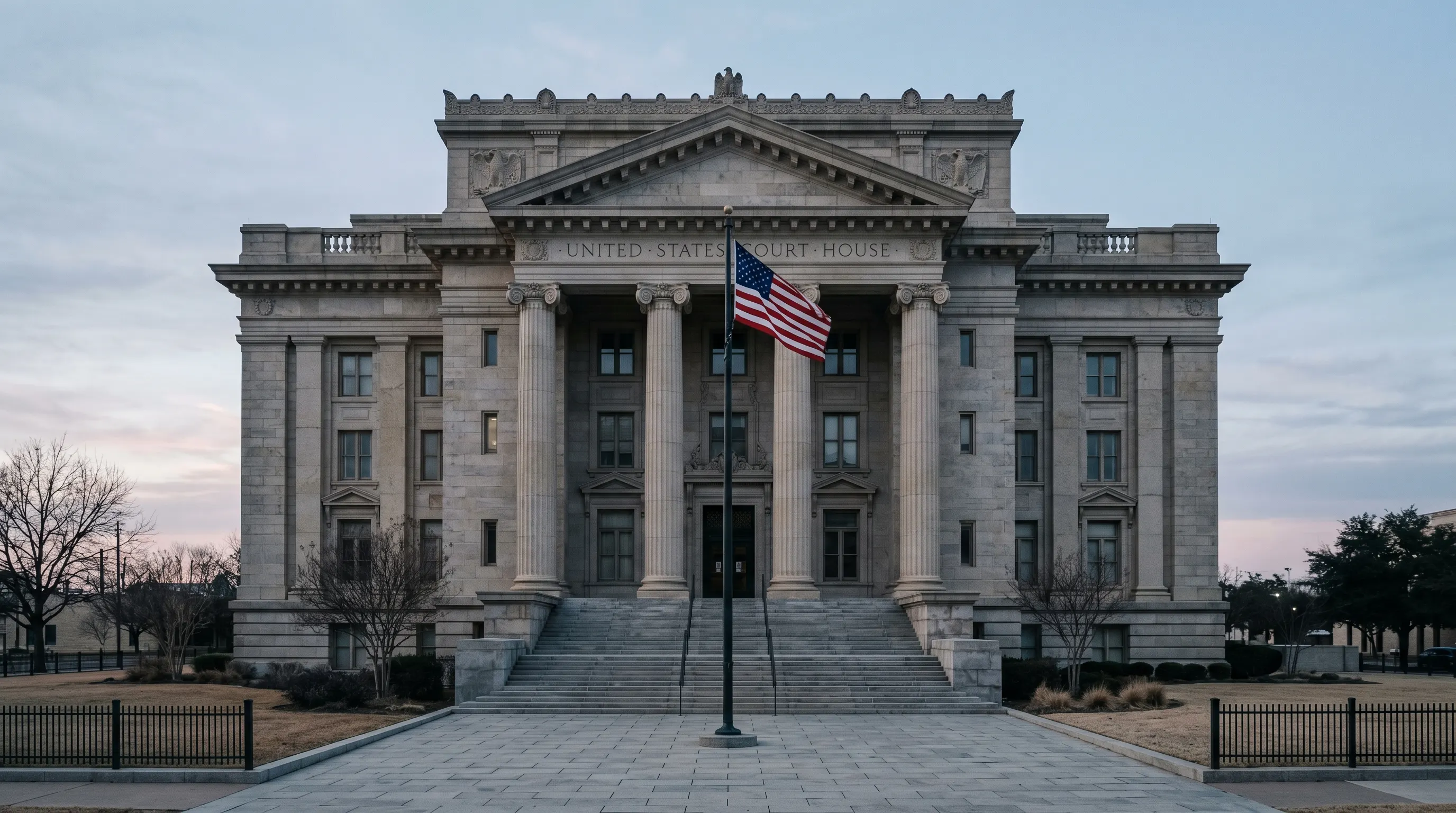
A federal case does not go to the Steindam Courts Building.
The first setting is an initial appearance before a federal magistrate judge under Federal Rule of Criminal Procedure 5. If the government seeks detention, a hearing under 18 U.S.C. §3142(f) follows within a few days. In drug cases carrying ten years or more and in §924(c) firearm cases, 18 U.S.C. §3142(e)(3) presumes you stay in custody unless the defense rebuts it.
Kent Starr has been licensed in Texas and trying criminal cases since 1997, including in the Collin County courts. His office is in McKinney.
How Federal Prosecution Differs from State Court
If you have experience with state court, federal court will feel different in almost every way, and not in your favor, without the right preparation.
State prosecutors carry large caseloads and often work toward quick resolutions. Federal prosecutors have smaller dockets, far more resources, and the backing of agency investigations that may have run for months or years before charges were ever filed. By the time a federal indictment is returned, the government typically has extensive evidence, financial records, wiretaps, cooperating witnesses, surveillance footage, that it has carefully organized into a case it expects to win. This does not mean the case cannot be beaten, but it does mean the defense must be equally thorough.
Grand juries. Federal indictments are returned by grand juries, typically without the defense ever appearing or offering its perspective. Grand jury proceedings are secret. If you receive a grand jury subpoena, either as a witness or as a target, you need an attorney before you respond to anything.
Federal bail. The Bail Reform Act of 1984 creates presumptions of detention in many federal drug and weapons cases. Federal detention hearings move quickly, and arguing for release requires specific preparation and documentation. A client who is detained while awaiting trial faces enormous practical obstacles in assisting with their own defense.
Federal sentencing guidelines. Unlike Texas state court, where judicial discretion is broader, federal sentences are shaped by the United States Sentencing Guidelines, a complex set of calculations that assign offense levels, adjust for criminal history, and produce a recommended sentencing range. Mandatory minimum sentences apply to many federal drug, weapons, and child exploitation charges, stripping judges of discretion to sentence below those floors. Understanding the guideline calculations, and finding every honest basis for a variance or departure, is one of the most valuable things a federal defense attorney does.
Federal and White Collar Charges We Handle
Federal drug trafficking. Distribution of controlled substances across state lines, large-quantity possession with intent to distribute, and conspiracy to traffic, all of these are federal rather than state matters when they reach the threshold quantities or geographic scope that triggers federal jurisdiction. Drug trafficking charges carry mandatory minimums of 5 to 10 years for many quantities, with 20 years and life sentences reserved for the highest tiers. Relevant conduct, the full scope of the alleged conspiracy, not just what was charged, drives the guideline calculation.
Wire fraud, mail fraud, and bank fraud. Any scheme to defraud that uses electronic communications or the postal system can give rise to a federal wire or mail fraud charge. Bank fraud under 18 U.S.C. §1344 applies to any scheme to defraud a federally insured financial institution. These charges are common in insurance fraud, mortgage fraud, business fraud, and financial crimes cases. Each use of email or the phone can be charged as a separate count, dramatically increasing potential exposure.
Healthcare fraud. The Department of Justice’s healthcare fraud strike forces have become extremely active in Texas, particularly in billing fraud cases targeting Medicare and Medicaid providers. Healthcare fraud is prosecuted aggressively, and the government often seeks asset forfeiture in addition to criminal penalties.
Federal weapons charges. Felon in possession of a firearm under 18 U.S.C. §922(g) is one of the most commonly charged federal offenses and carries a statutory maximum of 10 years. Armed career criminal enhancements can raise that dramatically. Charges involving firearms and drug trafficking in the same case often trigger mandatory minimums that stack with the underlying drug sentence.
Conspiracy. 18 U.S.C. §371 makes it a crime to conspire with one or more persons to commit any federal offense. Conspiracy charges are powerful tools for federal prosecutors because they allow the government to hold each co-conspirator responsible for the acts of all others in furtherance of the agreement, regardless of what any individual actually did. Charged co-conspirators face identical sentencing exposure even if one person was the organizer and another played only a minor role.
Tax crimes. Tax evasion under 26 U.S.C. §7201 and filing a false return under §7206 are felonies with maximum sentences of 5 and 3 years respectively, per count. Kent’s LL.M. in taxation from the University of Denver gives him a substantive background in tax law that directly informs how these cases are built and defended.
Federal child pornography charges. Possession, receipt, and distribution of child sexual abuse material (CSAM) are federal felonies prosecuted with extreme seriousness. Mandatory minimums of 5 years for receipt and distribution, and 10 years for production, apply. These cases require immediate, specialized defense, including forensic examination of digital evidence, investigation of how material was acquired, and analysis of all relevant conduct that will affect the guideline range.
Defense Strategies in Federal Cases
Suppression motions. The Fourth Amendment applies in federal court, and evidence obtained through an illegal search or seizure, whether of your home, your car, your phone, or your email accounts, can be suppressed. In federal cases, this often means challenging warrant applications to the magistrate who issued them, challenging the scope of the search, or arguing that a warrantless search exception does not apply.
Challenging cooperating witnesses. Federal prosecutors frequently build cases around cooperating witnesses, co-defendants who have entered plea agreements and agreed to testify. These witnesses have powerful incentives to shade, exaggerate, or fabricate testimony to satisfy prosecutors and reduce their own sentences. Kent Starr cross-examines cooperating witnesses by methodically exposing their incentives, their inconsistencies, and their credibility problems.
Guideline challenges. The sentencing guidelines are complex, and errors in their application are common. A miscalculated offense level, an improper criminal history category, or a failure to credit a guideline reduction (such as acceptance of responsibility or minor role) can mean years of additional imprisonment. Kent reviews every guideline calculation independently before sentencing and argues for every appropriate variance.
Pretrial motions and constitutional challenges. Federal courts require strict compliance with constitutional and procedural rules. Speedy trial challenges, bill-of-particulars demands, Brady disclosure motions, and Giglio challenges to the government’s obligation to disclose impeachment material about its own witnesses, all of these are standard practice in a thorough federal defense.
Federal cases run on the sentencing guidelines and on how the record will read on appeal. Kent builds the file with that in mind from the first interview.
Kent also handles the intersection between federal cases and related state-level charges. Federal drug indictments often run alongside state drug charge matters. A federal supervised-release violation can interact with state parole and probation violations. He handles the full picture.
Courts & Counties We Serve for Federal Cases
Kent Starr’s federal practice is based in McKinney and serves clients from Collin County, Dallas County, Tarrant County, Denton County, and surrounding North Texas counties. He practices before the United States District Courts for the Northern District of Texas (which includes Dallas, Fort Worth, Abilene, Amarillo, and Lubbock divisions) and the Eastern District of Texas (which includes Sherman, Marshall, Tyler, Beaumont, and Lufkin). Se habla español. Nós falamos português.
Frequently Asked Questions About Federal Criminal Charges
I received a target letter. What does that mean?
A target letter means the federal government has informed you that you are the target of a grand jury investigation, meaning they believe you have committed a crime and are building a case against you. This is one of the most serious documents you can receive. Do not respond without counsel. Do not speak with federal agents. Call a federal criminal defense attorney immediately. The decisions made in response to a target letter can have an enormous impact on how your case unfolds.
Should I cooperate with the government?
Cooperation, entering a plea agreement and testifying against others, can result in a substantial sentence reduction under USSG §5K1.1 if the government files a motion acknowledging your cooperation. But cooperation is irrevocable once entered, and the risks are significant: if the government does not file the motion, your cooperation may not benefit you at sentencing. Whether to cooperate is one of the most consequential decisions in a federal case and must be made with full information from counsel who has independently assessed the evidence against you.
How long do federal cases take?
Federal cases take longer than state cases. Pre-trial investigation and motion practice in a complex case can take a year or more. Trials can last days or weeks depending on the charges. Discovery in white-collar or fraud cases can involve millions of documents. The length of the process is one reason why having the right attorney early, when strategic decisions about cooperation, motions, and trial can still be made, matters so much.
What is the difference between federal probation and supervised release?
Federal “probation” is a sentence in lieu of imprisonment, while “supervised release” is a period of supervision that follows a federal prison term. Supervised release is mandatory for most federal felonies and can run from one year to life depending on the offense. Conditions typically include drug testing, restrictions on travel and association, and prohibitions on possessing firearms. Violating supervised release can result in return to prison for the remainder of the term.
Can federal charges be reduced or dismissed?
Yes. Federal charges are dismissed when evidence is insufficient, when suppression motions succeed, when prosecutorial misconduct occurs, or when the government cannot prove its case at trial. Charges are also frequently reduced through negotiated plea agreements. Kent Starr approaches every federal case by first assessing the strength of the government’s evidence honestly, then evaluating the possible defenses and resolutions.
How We Serve Collin County for Federal Criminal Defense
McKinney Federal Criminal Defense
Kent represents clients facing federal charges from McKinney. Federal matters arising in Collin County are prosecuted in the U.S. District Court for the Eastern District of Texas.
Plano Federal Criminal Defense
Kent represents clients facing federal charges from Plano. Federal matters arising in Collin County are prosecuted in the U.S. District Court for the Eastern District of Texas.
Frisco Federal Criminal Defense
Kent represents clients facing federal charges from Frisco. Federal matters arising in Collin County are prosecuted in the U.S. District Court for the Eastern District of Texas.
Allen Federal Criminal Defense
Kent represents clients facing federal charges from Allen. Federal matters arising in Collin County are prosecuted in the U.S. District Court for the Eastern District of Texas.
Contact Kent Starr for Federal Criminal Defense
If federal agents have already contacted you, do not speak with them again before retaining counsel. If a target letter is already in your hands, time is shorter than it feels. Call (214) 982-1408 to schedule a free, confidential consultation with Kent. Free initial consultation. Payment plans available. Se habla español. Nós falamos português.
Past results do not guarantee future outcomes. Every case is evaluated on its own facts.
ADVERTISEMENT. This site is attorney advertising. Kent Starr is responsible for the content of this website. Information provided here is general and is not legal advice; reading this page does not create an attorney-client relationship.
Many federal matters start as Collin County arrests before they move to the Eastern District. The firm's guide to criminal defense in Collin County covers the county side of that line.
Field notes
All 3 articles on Federal Criminal Defense
Criminal defense across Collin County.
One office in McKinney, the county seat. If you were arrested or charged in any Collin County city, from Plano and Frisco to Anna and Farmersville, your case runs through the courts here, and Kent handles it himself. Frisco and Plano arrests that land in Denton County, and Richardson or Sachse arrests that land in Dallas County, are handled too.
[ Client Reviews ]
What clients say about working with Kent.
5.0 · Hundreds of Google reviews
-
I chose Mr. Starr after speaking with more than 15 different law firms, and it was one of the best decisions I could have made.
From day one, he was personable, direct, and incredibly patient with all of my questions. What really stood out was that I was able to communicate directly with him throughout the entire process. I was never passed around to a secretary or assistant. Whenever I had a concern or needed an update, I could text him directly and he was always responsive and available.
Christina Martin Google review -
I couldn't be more satisfied with my experience working with Mr. Starr. He has been professional, attentive, and clearly very knowledgeable from day one. Throughout the entire process, Mr. Starr kept me well-informed and made sure I understood my options at every stage.
Mr Starr was thorough, responsive, and always seemed one step ahead, which gave me a lot of confidence during a stressful time.
I'm truly grateful for his dedication and would absolutely recommend him to anyone looking for effective and dependable legal representation.
Nick H Google review -
Just had a chat with Mr. Starr and he was extremely knowledgeable and kind, provided me with information regarding my case that helped lift a massive weight off my shoulders.
I plan on having him represent me going forward and I have full confidence in his ability to provide accurate and helpful input.
Brendan Hendershott Google review
[ 07 / Consultation ]
Talk to a lawyer first.
Request a consultation. We answer the phone, including on Sundays.