
By Kent Starr, Starr Law, P.C., 5900 South Lake Forest Drive, Suite 200, McKinney, Texas 75070.
An evading arrest or detention charge involving a motor vehicle can put a driving record, employment, and liberty at risk. The offense must be graded correctly from the beginning. Section 38.04 is unusually confusing because the official code prints two overlapping 2011 versions of subsection (b), while Texas appellate decisions have explained which version controls.
If this is your situation right now: you or a family member was charged with evading arrest or detention involving a vehicle, and online information does not match what a lawyer is telling you. Kent Starr handles felony evading and related traffic cases in the Collin County courts and takes every consultation himself. Free and confidential: (214) 982-1408.
Why online sources can give conflicting answers
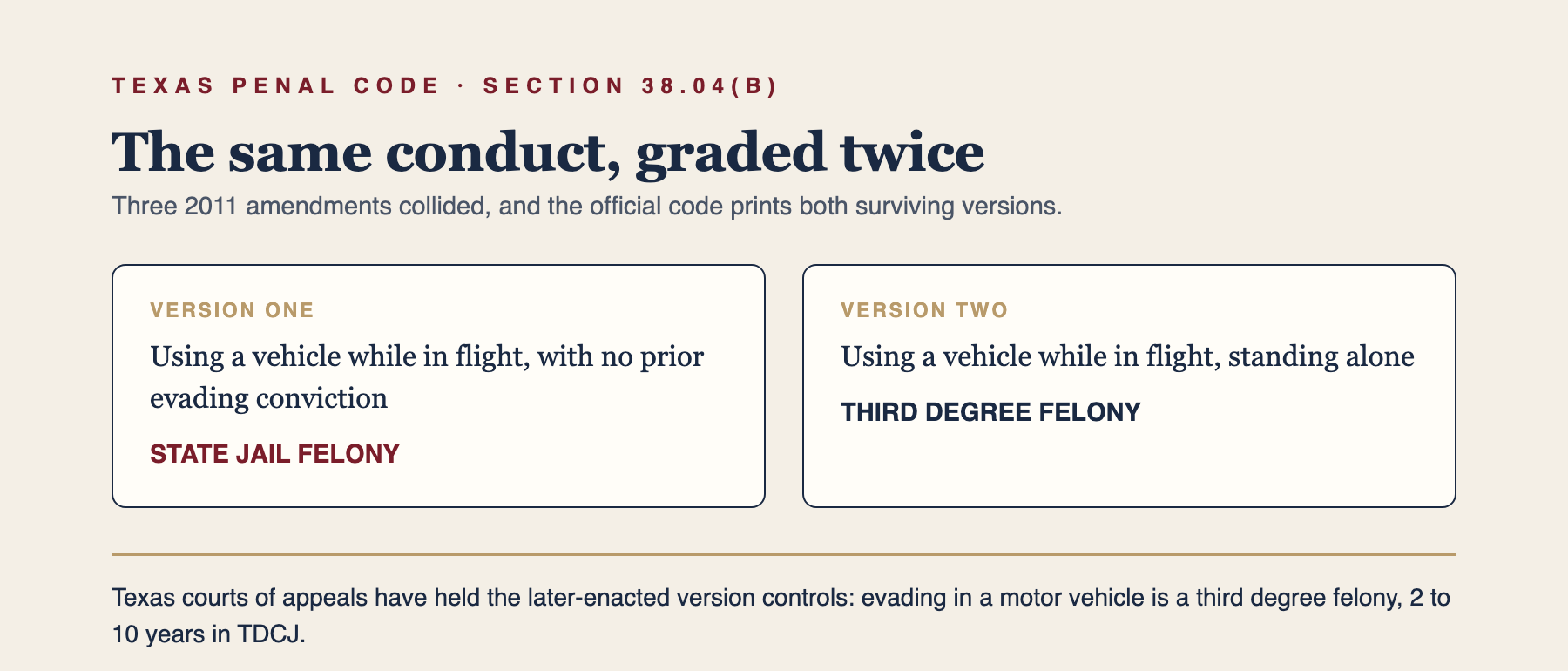
Some online sources describe evading arrest in a vehicle as a state jail felony, with a range of 180 days to 2 years. That description reflects one version of the 2011 amendments to Section 38.04(b), which remains printed alongside another version in the official code.
Texas courts of appeals that have addressed the overlapping amendments have held that the later, more comprehensive version controls. Under that construction, using a motor vehicle while fleeing makes the offense a third degree felony, generally punishable by 2 to 10 years of imprisonment and a fine of up to $10,000 under Penal Code Section 12.34.
That distinction matters. The grade alleged in a charging instrument can affect the court, the applicable punishment range, the parties’ evaluation of the case, and the sentencing consequences. It should be evaluated from the current statute, the charging allegations, and applicable appellate decisions, not from a search-result summary alone.
How a statute ends up with two answers
Section 38.04 grades evading arrest or detention at different levels depending on the conduct alleged and, in some circumstances, prior convictions or injury-related allegations. The applicable subsection and statutory version matter.
The overlapping amendments created two incompatible punishment schemes. The official Texas statutes website displays both versions of subsection (b), with notes identifying the acts that amended the provision. That presentation can create confusion when a secondary source reproduces one version without discussing the appellate decisions interpreting the amendments.
The statutory text should therefore be read together with the controlling appellate decisions, rather than by selecting one printed version in isolation.
What the courts of appeals have held
Texas courts do not leave contradictions like this open. Courts of appeals in Fort Worth, Amarillo, and Tyler have all taken up the 2011 amendments’ effect on evading in a vehicle:
- In Adetomiwa v. State, 421 S.W.3d 922 (Tex. App.—Fort Worth 2014), the court worked through the competing amendments and the two printed versions of Section 38.04.
- In Peterson v. State, No. 07-13-00155-CR (Tex. App.—Amarillo 2014), the defendant used a vehicle, had no prior evading conviction, and was sentenced to ten years. The Amarillo court held that the later-enacted version of the amendments prevails, so that using a motor vehicle alone makes evading arrest a third degree felony. The judgment was affirmed.
- In Thompson v. State, No. 12-13-00264-CR (Tex. App.—Tyler 2014), the court applied the same rule.
The pattern is consistent: when the two versions conflict, the version from the last bill to pass controls, and that version raises evading in a motor vehicle to the third degree. The state jail reading survives in the code as a printing, not as the operative law.
General offense levels under Section 38.04
The charge level depends on the version of the statute that applies, the conduct alleged, and any applicable enhancement allegations. In general:
- Class A misdemeanor. Evading arrest or detention without a vehicle and without a prior conviction under Section 38.04 may be charged as a Class A misdemeanor. The ordinary range is up to one year in county jail and a fine of up to $4,000.
- State jail felony. A prior conviction under Section 38.04 may raise the offense to a state jail felony. The ordinary range is 180 days to 2 years of confinement and a fine of up to $10,000.
- Third degree felony. Under the appellate construction of the controlling 2011 amendment, use of a motor vehicle while in flight is a third degree felony. Certain serious-bodily-injury allegations and tire-deflation-device allegations can also raise the offense to this level under the statute. The ordinary third-degree range is 2 to 10 years of imprisonment and a fine of up to $10,000.
- Second degree felony. A death allegation, or certain serious-bodily-injury allegations involving a tire deflation device, may raise the offense to a second degree felony. The ordinary range is 2 to 20 years of imprisonment and a fine of up to $10,000.
Other statutes and enhancement provisions can alter the available range. The charging instrument and a lawyer’s review of the current law determine the grade in an individual case.
Why the difference matters before a plea
The distinction between a state jail felony and a third degree felony is significant. The alleged offense level can affect the available punishment range, the court handling the case, the parties’ evaluation of a plea offer, and the consequences of a sentence. A lawyer should evaluate the current statute, the charging instrument, and applicable case law before a plea decision is made.
A felony conviction can have collateral consequences beyond confinement. Depending on the offense, disposition, and a person’s history, those consequences may involve future eligibility for relief from records, firearm restrictions, employment, licensing, immigration, and later charging or punishment issues. Those consequences require case-specific legal review.
What a defense looks at in an evading case
Every evading case turns on its own facts, but the same questions come up in most of them:
- Was an officer attempting a lawful arrest or detention? The statute requires intentional flight from a person the accused knows is a peace officer or federal special investigator attempting lawfully to arrest or detain them. Whether a detention was lawful can be a significant legal issue, but the effect of an unlawful detention depends on the facts and applicable law.
- Did the driver know it was an officer? The statute requires that the person knew the officer was attempting an arrest or detention.
- Did the person actually flee, and in what? The facts decide whether the conduct is on foot or in a vehicle, and the grade follows.
- Does an injury enhancement really attach? Serious bodily injury and death provisions require that the injury be caused by the attempt to apprehend the driver, and that causation is proven with evidence, not assumed.
- What do the reports and available recordings show? Video, dispatch information, officer reports, witness accounts, and other evidence may matter. The evidence available in any individual case should be reviewed closely.
Evading cases in the Collin County courts
A case arising in Collin County may be handled in a county court at law or a district court depending on the charge level and the procedural posture. A felony allegation may proceed through indictment and district-court proceedings, while a misdemeanor allegation may be handled in a county court at law. The charging instrument, offense grade, and facts determine the path of a particular case.
Kent Starr has practiced criminal defense in Collin County since 1997 and handles evading and traffic-related felony cases from his office in McKinney. The consultation is free and confidential, and Kent takes it himself. Call (214) 982-1408 or send a confidential message through the contact page.
This article is general information about Texas law. It is not legal advice, and every case turns on its own facts.
References
- Texas Penal Code, Chapter 38 (Section 38.04, Evading Arrest or Detention, including both amended versions of subsection (b))
- Texas Penal Code, Section 12.34 (Third Degree Felony Punishment)
- Texas Penal Code, Section 12.35 (State Jail Felony Punishment)
- Adetomiwa v. State, 421 S.W.3d 922 (Tex. App.—Fort Worth 2014)
- Thompson v. State, No. 12-13-00264-CR (Tex. App.—Tyler 2014)
- Peterson v. State, No. 07-13-00155-CR (Tex. App.—Amarillo 2014)
- S.B. 1416, 82nd Texas Legislature, Regular Session (enrolled text)
- H.B. 3423, 82nd Texas Legislature, Regular Session (enrolled text)
- S.B. 496, 82nd Texas Legislature, Regular Session (enrolled text)
Related Articles
Frequently asked questions
- Is evading arrest in a motor vehicle a state jail felony or a third degree felony in Texas?
- Texas appellate decisions have held that the third degree felony classification controls when a person uses a motor vehicle while in flight. Senate Bill 1416, enacted in 2011, made use of a vehicle while fleeing a third degree felony, and courts addressing the overlapping 2011 amendments have treated that later, more comprehensive amendment as controlling. A third degree felony generally carries 2 to 10 years of imprisonment and a fine of up to $10,000. Some older or unmaintained sources reproduce the earlier version of the statute and describe the offense as a state jail felony, which can cause confusion.
- What is the punishment for felony evading in a motor vehicle in Texas?
- A third degree felony is generally punishable by 2 to 10 years of imprisonment and a fine of up to $10,000 under Penal Code Section 12.34. The available punishment and place of confinement can be affected by the charging allegations, the applicable statutes, criminal history, and sentencing provisions. If another person suffers serious bodily injury or death as a direct result of an attempt to apprehend the person while the person is fleeing, the offense may be enhanced beyond the third degree.
- Why do FindLaw and AI chat tools say it is a state jail felony?
- In 2011, multiple bills amended subsection (b) of Section 38.04. The official code displays two versions of that subsection, reflecting overlapping amendments. Some legal-information sources reproduce both versions without explaining how appellate courts have resolved the conflict. AI tools can repeat that ambiguity or rely on older secondary sources. Texas courts of appeals have addressed the conflict and treated the later, more comprehensive amendment as controlling.
- Which courts have ruled on this?
- Texas courts of appeals in Fort Worth, Amarillo, and Tyler have addressed the overlapping 2011 amendments. In Adetomiwa v. State, the Fort Worth court analyzed the amendments and concluded that use of a motor vehicle while fleeing makes the offense a third degree felony. In Peterson v. State, the Amarillo court applied that reasoning and affirmed a ten-year sentence. Thompson v. State followed the same statutory analysis.
- Does a previous evading conviction change the charge?
- A prior conviction under Section 38.04 can independently raise evading arrest or detention to a state jail felony. When a person also uses a motor vehicle while in flight, Texas appellate decisions treat the vehicle allegation as supporting the third degree felony classification. Prior convictions may also affect punishment under other applicable sentencing provisions.
- What should I do if the charge on my paperwork looks wrong or I do not understand the grade?
- Take the charging instrument and any bond paperwork to a criminal defense lawyer for review. A lawyer can compare the alleged offense level and cited statute with the current law, the charging allegations, and the facts of the case before a plea decision is made. Kent Starr handles criminal cases in the Collin County courts and takes the consultation himself.